
How to Select a Control Valve for Your Process
Selecting a control valve requires matching the valve structure and actuator to your process conditions. The most critical factors are the medium characteristics, required flow rate, pressure drop, and temperature. Whether your application involves chemical processing or water treatment, reviewing the industry solutions helps outline the specific requirements. The right choice ensures stable regulation, while an incorrect selection may lead to poor controllability, cavitation, or premature wear. This guide outlines the key steps to review before requesting a quotation.
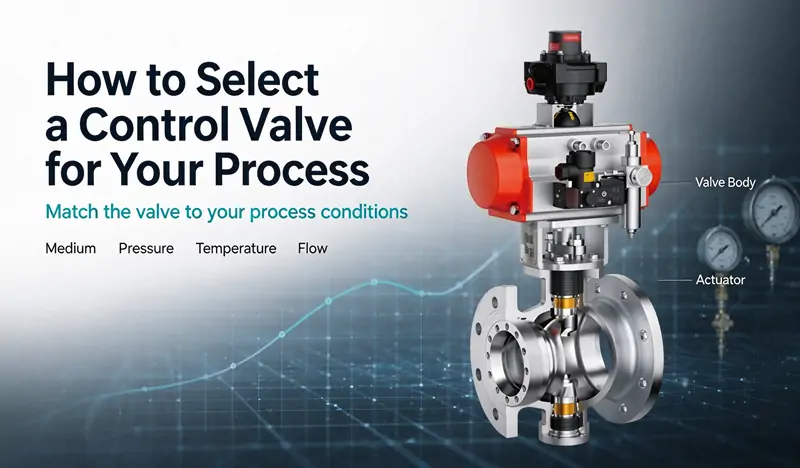
Step 1: Define the Process Conditions
Before reviewing industrial control valves, document the operating conditions. Incomplete data is a common reason for incorrect valve sizing.
- Medium: Water, steam, gas, oil, or chemical fluids. Check for corrosive properties or suspended solids.
- Pressure: Inlet pressure, outlet pressure, and the maximum differential pressure.
- Temperature: Normal operating temperature and extreme limits.
- Flow Rate: Minimum, normal, and maximum flow rates.
Step 2: Choose the Valve Structure and Flow Characteristic
The internal structure of the valve affects how it regulates flow. Common structures include single-seat, double-seat, and cage-guided valves. You also need to select the flow characteristic:
- Equal Percentage: Ideal for temperature and pressure control where most of the pressure drop occurs at low flow.
- Linear: Suitable for level control and constant pressure drop systems.
- Quick Opening: Used for on-off applications or specific safety bypasses.
Step 3: Select the Actuation Method
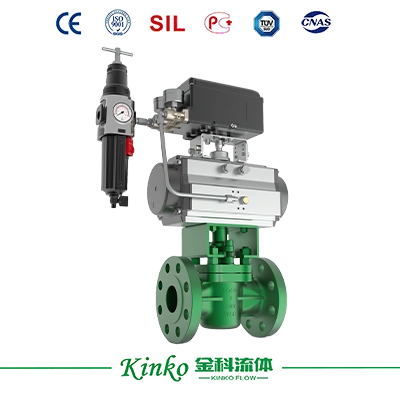
The actuator drives the valve stem. The choice usually depends on available energy and control requirements. You can compare pneumatic control valves and electric control valves based on the following:
- Pneumatic: Fast response, requires a clean air supply, and needs a positioner for modulating control.
- Electric: Slower response, but uses standard power and provides precise positioning without an air supply.
Step 4: Confirm the Sizing and Flow Coefficient (Cv)
Sizing determines the valve capacity. An oversized valve may operate near the closed position, causing poor control and unstable flow. An undersized valve cannot deliver the required capacity. Calculating the Cv value ensures the valve opens at an optimal percentage (typically 60% to 80%) under normal flow conditions.
Step 5: Review Materials and Connections
Material compatibility is critical for valve longevity. You can review the manufacturing processes and quality controls on our factory capability page to understand how material integrity is maintained.
| Component | Common Options | Selection Consideration |
|---|---|---|
| Valve Body | Cast steel, Stainless steel (CF8/CF8M), PTFE-lined | Corrosion resistance and pressure rating |
| Valve Trim | Stainless steel, Hardened steel, Stellite | Erosion and wear resistance |
| Seal / Packing | PTFE, Graphite, Metal seat | Temperature limits and shutoff class |
Step 6: Select the Required Accessories
To complete the control loop, accessories may be necessary. If precise modulating control is required, a valve positioner should be configured with the actuator. Limit switches can be added for remote position feedback, and air filter regulators are essential for pneumatic setups to ensure clean air.
Control Valve Selection Checklist
Gather these details before contacting a supplier:
- Medium and its corrosive/abrasive properties
- Maximum and normal flow rate
- Inlet and outlet pressure
- Operating temperature
- Pipe size and connection type
- Required flow characteristic (linear, equal percentage, quick open)
- Actuation preference (pneumatic or electric)
- Fail-safe requirement (fail-open, fail-close, fail-in-place)
- Required shutoff class (e.g., Class VI)
Once you have gathered this data, you can contact our technical team for a formal sizing review and quotation.
FAQ
What is the difference between a control valve and an on-off valve?
An on-off valve (like a standard ball valve) is designed to fully open or fully close. A control valve is designed to modulate flow by positioning the plug or disc at various intermediate points to maintain pressure, temperature, or flow rate.
How do I determine the valve size if I only have pipe size?
Pipe size alone is not sufficient. Valve sizing requires calculating the flow coefficient (Cv) using the actual flow rate, pressure drop, and specific gravity of the medium. Using pipe size to select a control valve often results in oversized valves.
When should I use a pneumatic control valve with a positioner?
A pneumatic control valve needs a positioner when the process requires precise modulating control or when the valve operates under high differential pressure and friction. The positioner ensures the valve reaches the exact position commanded by the control signal.
What causes cavitation in control valves?
Cavitation occurs when the pressure of the liquid drops below its vapor pressure inside the valve, forming vapor bubbles that collapse as pressure recovers. It causes noise, vibration, and physical damage to the valve trim.
Can electric control valves be used for fast emergency shutdown?
Electric actuators are generally slower than pneumatic spring-return actuators. For rapid emergency shutdown (ESD) requirements, pneumatic actuators with spring-return mechanisms are often the preferred choice, as they can close the valve quickly upon air failure.