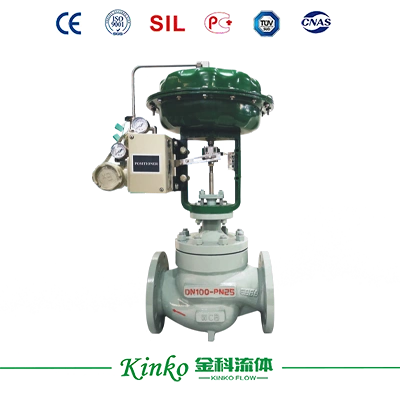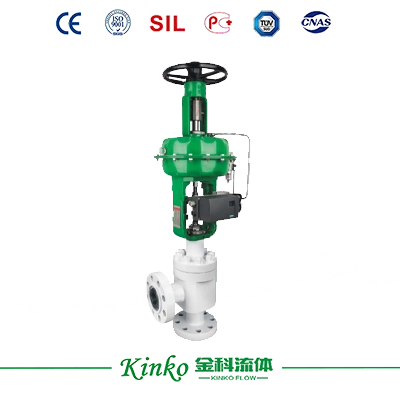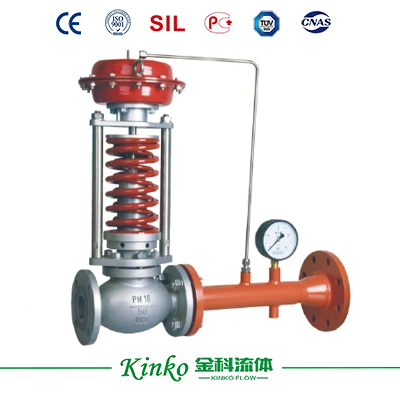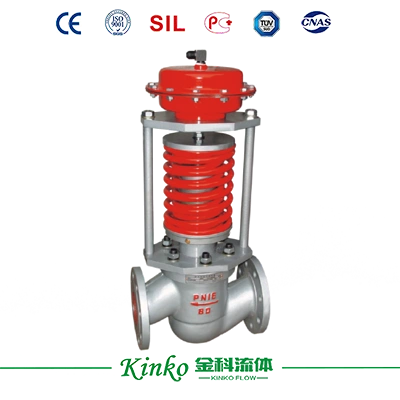
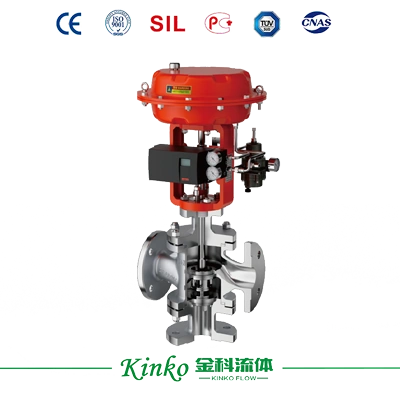
The ZPL310Y/ZPL320Y series pneumatic 3-way converging/diverting control valve features a dual-valve-plug structure with upper and lower guiding, paired with various spring actuators. The valve body has a 4-way structure, available in two configurations: one-inlet-two-outlets (diverting type) for fluid splitting or two-inlets-one-outlet (converging type) for fluid mixing. These configurations enable functions such as temperature adjustment through fluid mixing or uneven liquid diversion, meeting diverse operational requirements.
Product Overview
The valve body offers advantages including compact structure, light weight, sensitive action, minimal pressure drop loss, high allowable pressure difference, large capacity, precise flow characteristics, and easy maintenance. It is suitable for various working conditions, particularly temperature control systems in petroleum industry heat exchangers and automation control across industries. Available in multiple forms such as standard types and high-temperature types, the product offers pressure ratings of PN1.6,4.0, and 6.4; sizes ranging from DN25 to 200; leakage classes II and IV; and flow characteristics of linear and equal percentage. A wide range of specifications is available for selection.

Specifications
| Body Type | 3-Way Converging/Diverting Type | ||
| Size | DN25~DN200 | ||
| D & M Std. | GB/T4213 | ||
| F2F Std. | GB/T12221 | ||
| PT & I Std. | GB/T4213,API598 | ||
| Conn. Std. | Flange Sealing Face | RF, FM/M, T/G, FF | |
| HG/T20592 | PN10, PN16, PN25 | ||
| ASME B16.5 | 150LB | ||
| Sealing Type | Seat Type | Metal Seated | |
| Stem Sealing Type | Packing Sealing, Bellows Sealing | ||
| Materials | Body/Bonnet Material | WCB, LCB, SS304, SS316L | |
| Plug Material | WCB, F304, F316L | ||
| Stem Material | 17-4PH | ||
| Packing Material | PTFE | ||
| Technical Parameters | Temperature Range | -30℃~160℃ | |
| Flow Characteristic | Equal percentage(EQ%)/ Linear(LIN)/ Quick opening(QO) | ||
| Leakage Level | IEC 60534-4, ANSI FCI 70-2, ASME B16.104 | ||
| Rangeability | 50:1 | ||
| Basic Error | w/o pos.:≤±8%, w/pos.≤±1.5% | ||
| Hysteresis Error | w/ pos.≤1.5% | ||
| Dead Band | w/o pos.:≤6%, w/pos.: ≤0.5% | ||
| Accessories | Actuator | Pneumatic Actuator | ZP6100 Series ZP6200 Series |
| Electric Actuator | ZP8000 Series | ||
| Main Accessories | Positioner, Air Filter Regulator, Handwheel | ||
| Others | Limit Switch, Solenoid Valve, position transmitter, Volume booster, Lock-up valve | ||
| Features | Description |
| Multi-Application | This 3-way control valve enables multi-scenario flow switching between diverting (1-inlet/2-outlet) and combining (2-inlet/1-outlet) configurations. |
| Dual-Disc Control Structure | The independent disc-seat paired configuration enables one disc to open while the other synchronously closes, achieving precise flow splitting or merging control |
| Dual-Function Stabilization | The sleeve with balance holes reduces fluid-induced unbalanced forces, improving stability. The disc sidewall, seat bore, and upper bushing form a cooperative guidance system to enhance vibration resistance |
| Application & Cost Saving | This valve can replace the combination of an air-to-open valve and an air-to-close valve, reducing costs by over 30%, saving installation space, and being suitable for bypass control, fluid ratio adjustment, and similar applications |
| Leakage Class State | Standard leakage class I~IV, upgradable to Class IV (Enhanced Sealing Requirement) through advanced cage trim optimization |
| Selectable Flow-Char. | Flow characteristic selectable between linear and parabolic, adapting to varying process requirements and control precision needs |
Downloads

Application & Case
Lorem ipsum dolor sit amet, consectetur adipiscing elit. Aenean euismod bibendum laoreet. Proin gravida dolor sit amet lacus accumsan et viverra justo commodo. Proin sodales pulvinar sic tempor. Sociis natoque penatibus et magnis dis parturient montes, nascetur ridiculus mus. Nam fermentum, nulla luctus pharetra vulputate, felis tellus mollis orci, sed rhoncus pronin sapien nunc accuan eget.